The sacred story of bees. The timelessness of God’s gifts.
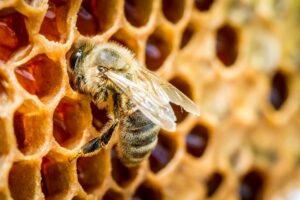
Here’s a delightful snapshot of bees on a honeycomb—nature’s miniature tapestry of sweetness and symmetry.
That gentle hum, the golden comb, the quiet choreography. Bees carry centuries of myth and meaning. Bees weave not just honey, but metaphors: for wisdom, unity, divine design.
But bees don’t just carry metaphor – they carry miracles in chemistry too. Let’s taste the knowledge they’ve been storing for millennia.
Explore honey-drizzled knowledge:
- Honey is basically immortal. Archaeologists found pots of honey in ancient Egyptian tombs — thousands of years old — still edible. The secret? Low water content and natural acidity keep bacteria away. So that jar you buy might outlive your grandkids.
- Raw honey is alive (in a good way). It contains enzymes (like glucose oxidase) that help produce hydrogen peroxide, giving honey mild antibacterial powers. This is why your gran swears it heals sore throats.
- Bees change the flavor depending on the flowers. Clover honey tastes delicate, sunflower honey is bold, eucalyptus honey has that herby edge. It’s literally terroir, like wine — but from buzzing sommeliers.
- Crystallisation isn’t spoilage. Raw honey often crystallises because it hasn’t been heated or filtered. That’s a sign it’s pure. Warm it gently in hot water (not the microwave) and it’ll go liquid again.
- War-time medicine. During WWII, when antiseptics were scarce, honey was smeared on wounds to prevent infection. Not just sweet — practical survival goo.
- Bees make honey by spitting. They collect nectar, chew it with enzymes, then pass it mouth-to-mouth to other bees until it thickens. Sounds gross, but without that spit, you’d just have floral sugar water.
So, when you scoop a spoonful of raw honey, you’re tasting sunshine, flower chemistry, bee teamwork, and a dash of ancient immortality.
Don’t get hustled. Are you holding a jar of sunlight, or just sugar water in disguise?
Now, the tricks to spot real, raw honey (so you don’t accidentally buy syrup in disguise):
- The Water Test
Drop a spoon of honey in a glass of water.- Raw honey will clump and sink slowly, holding shape.
- Fake/adulterated honey dissolves quickly or spreads like sugar water.
- The Thumb Test
Put a small drop on your thumb.- Raw honey stays put, thick and sticky.
- Fake honey runs off like syrup.
- Flame Test (old-school, careful with this one)
Dip a cotton wick or match into honey, then try to light it.- Raw honey may let the wick burn because it has little to no added moisture.
- Fake honey (with water or syrups) won’t ignite easily.
- Crystallisation is your friend
- Raw honey often crystallises (grainy, opaque look) because of natural glucose.
- Fake honey tends to stay smooth and runny (they add syrup to prevent crystals).
- Taste & Aroma
Raw honey isn’t just sweet — it has layers: floral, herbal, sometimes woody. Fake honey is one-dimensional sugar water.
So the next time you drizzle honey into your tea, or let it melt on warm bread, remember — you’re tasting more than sweetness. You’re tasting sunlight gathered by flowers, carried by bees, preserved by time itself. You’re tasting teamwork, divine design, and the timeless generosity of creation.
In every golden drop there’s a quiet sermon: life is fragile, but also enduring. Ordinary things — bees, flowers, honey. They each carry eternal lessons. And like honey, God’s gifts never spoil.
Aren’t we blessed?
With love always,
Eugene Marillier 🕊️🌿


I enjoyed reading this article. Thanks for sharing your insights.
Hi there
Thank you so much.
Many blessings…
Much Love.
Eugene
Love this!
Hey, hey
Thank you.
Blessings girla…always!